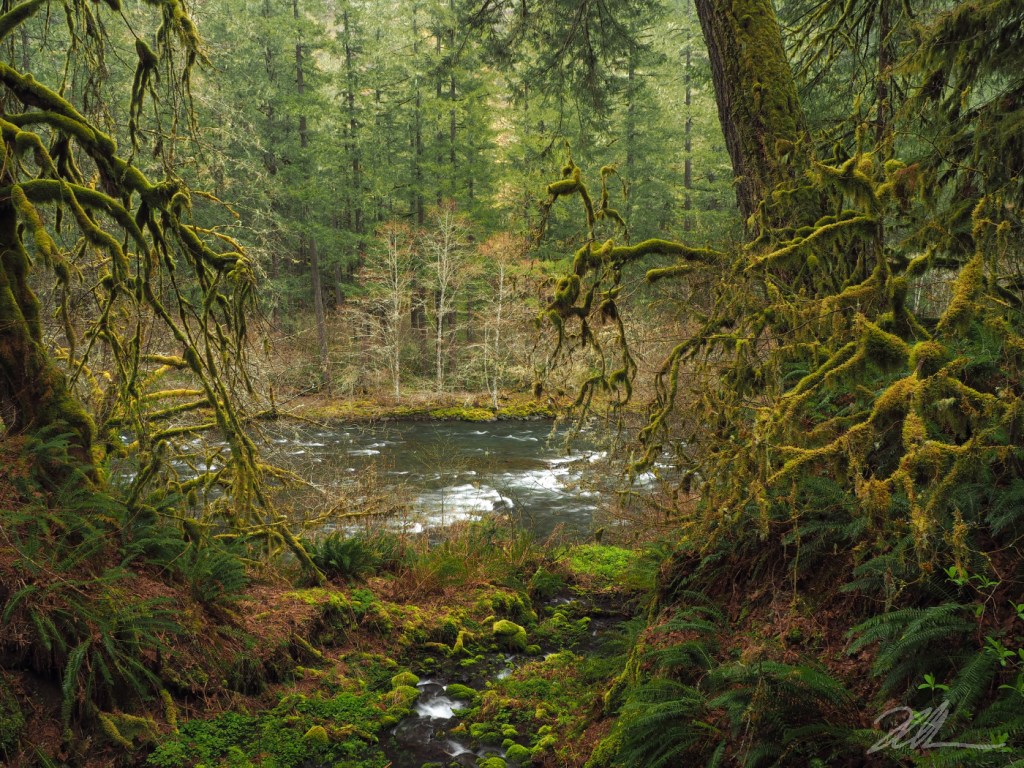
• Of the big rivers that flow from the rainy western slopes of the Oregon Cascades, the Molalla might be the most abused by a century of heavy logging, thanks to private timber holdings that span much of the watershed. Yet, in the midst of nearly continuous clearcuts and logging spur roads a ribbon of beautiful rainforest survives along the lower river. This land is held by the Bureau of Land Management, and forms the Molalla Recreation Corridor. While spared the corporate chainsaws, this green ribbon of public land was hit hard by the Riverside Fire that swept through in September 2020. 

    While some trees survived the fire, though this verdant scene along the Molalla is now mostly a memory. The mossy, gnarled Bigleaf map on the left still stands, though as a bare skeleton killed by the fire. The big Douglas fir leaning in from right collapsed entirely into the river, leaving only the shards of its burned-out trunk. The forest across the river fared better, with most of the tall Douglas fir stand surviving, as did the trio of Red alder trees along the riverbank. The mossy spring in the foreground is little changed, surprisingly, as most of the ferns and understory have bounced back from the fire and are now thriving.
    ___________

    Image Description: White riffles mark a wide, rambling mountain river, framed by a gnarled, moss-covered Bigleaf maple on the left and the thick, dark trunk of a large Douglas fir on the right. Across, the river, a stand of tall, straight Douglas fir with dark trunks rise behind a trio of white-barked Alder trees.  A clear, tumbling spring pours through moss-covered rocks in the foreground.

    Photo © WyEast Images (2026)
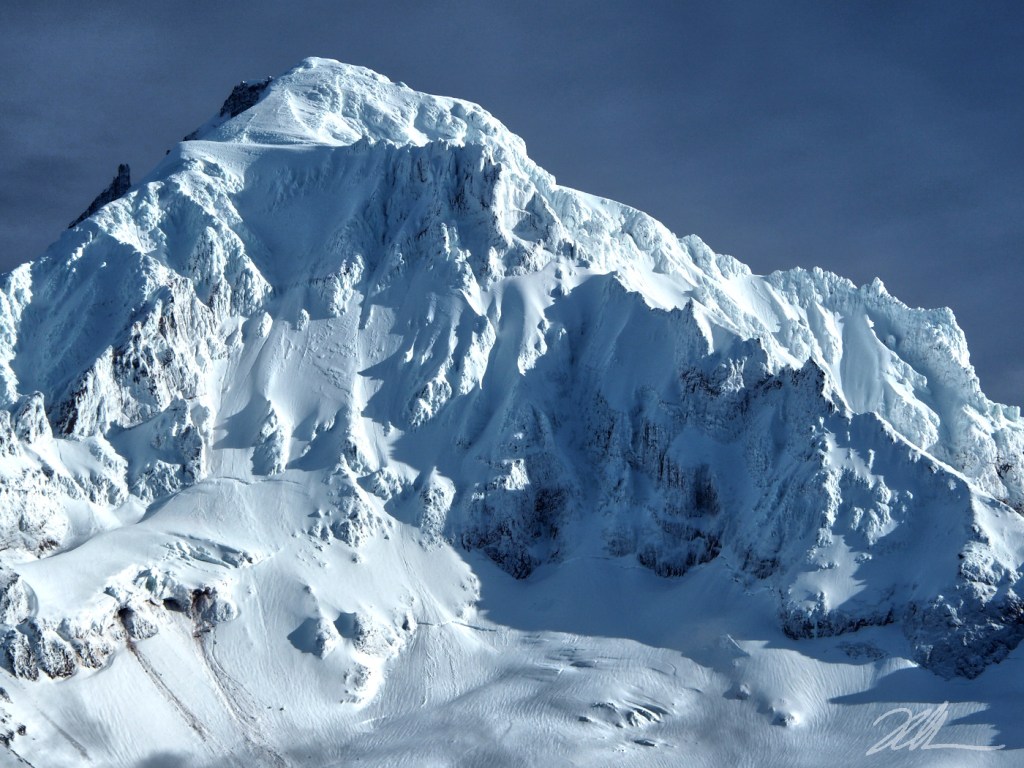
  • Winter snow means the annual closure of Lolo Pass Road, and the beginning of a very quiet season on the rugged northwest side of Mount Hood. It’s a time of stunning beauty, when the colorful cliffs and spires familiar to summer hikers are blanketed in deep snow and ice. This image was captured in early winter, after the first big snowstorms had arrived, but before the coldest winter temperatures had set in, leaving Lolo Pass accessible with just a foot of snow to navigate.

    This perspective shows the imposing Sandy Headwall, a near-vertical 2,000-high ring of cliffs that shed constant snow avalanches to supply the Sandy Glacier. Crevasses seen in the lower part of this view mark the upper extent of the glacier. 

    Climate change is causing all of Mount Hood’s glaciers to recede, and the Sandy is among the most affected due to its comparatively low elevation. Its origin, at just 8,800 feet, is the lowest among the active glaciers on the mountain. This rapid melting led to the formation of the spectacular Sandy Glacier Caves several years ago, a much studied and documented phenomenon, though fleeting in their existence.

    ___________

    Image Description: Rugged, pyramid-shaped Mount Hood is draped in heavy snow with long evening shadows creating contrasting shades of blue and white. Dark, rocky pinnacles and ridges push through the snow on the steepest parts of the mountain. Behind the mountain, the sky is a light mist of clouds against dark blue sky. Wrinkles in the smooth, snow-covered Sandy Glacier at the base of the mountain mark crevasses in the ice.

    Photo © WyEast Images (2026)

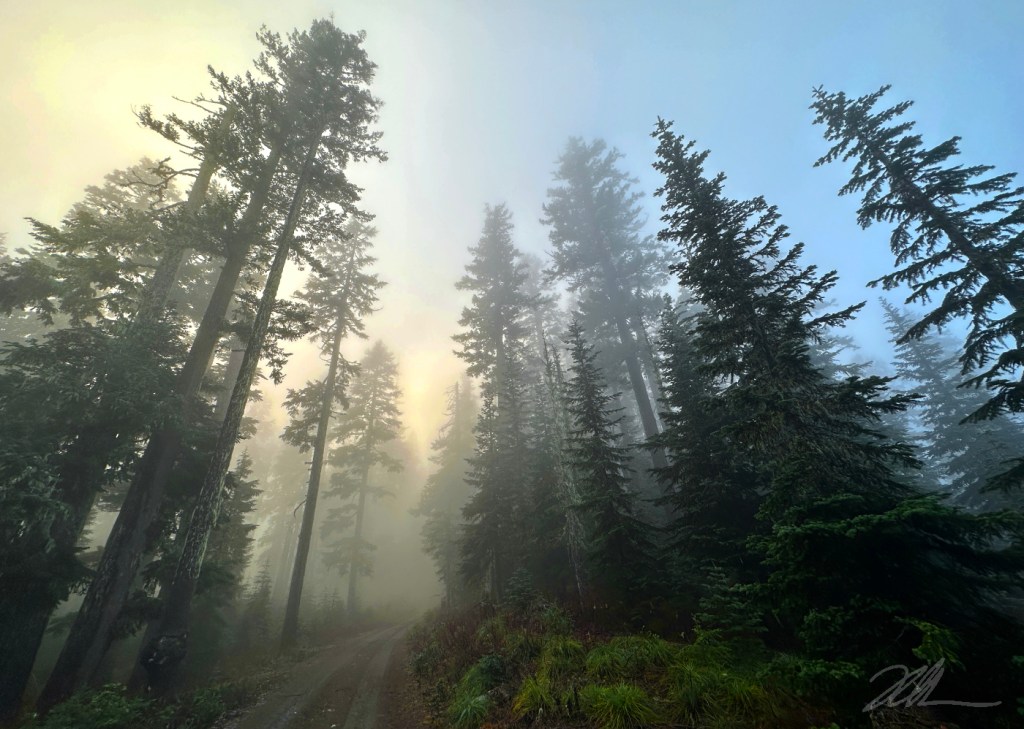
  • When the days get shorter each winter, and the sun is low on the southern horizon, thick mountain fog can seemingly appear out of nowhere as evening approaches on cold, clear days. Though invisible to our eye, the clear winter air is usually dense with water vapor barely held in suspension by the sun’s rays. As the sun begins to fade toward sundown, so does the energy needed to sustain vapor, and droplets of water quickly condense to form fog. 

    This scene is along the historic Bennett Pass Road where it follows the high ridge dividing the East Fork Hood River and White River valleys. The image captures a moment at the end of a late November when dense fog had already engulfed the East Fork valley (on the right), where the ridge had already blocked the setting sun. Fog was quickly forming on the White River side (left), as well, lit up in this scene with the last rays from the setting sun. 

    Ridges and peaks are often left as islands above the fog, with the heavy, condensed air sinking into valleys, below. In this scene, the fog buildup had nearly crested the ridge, though clear skies remained visible overhead.

    ___________

    Image Description: Ancient Noble fir trees tower 150 feet above a narrow wagon road disappearing into flog along a forested Cascade Mountain ridgetop. The dense fog filters through the trees, partly illuminated gold and yellow with rays from the setting sun. Tufts of bright green Beargrass (an alpine member of the Lily family) grow in the foreground, their sword-shaped leaves heavy with dew.

    Photo © WyEast Images (2026)

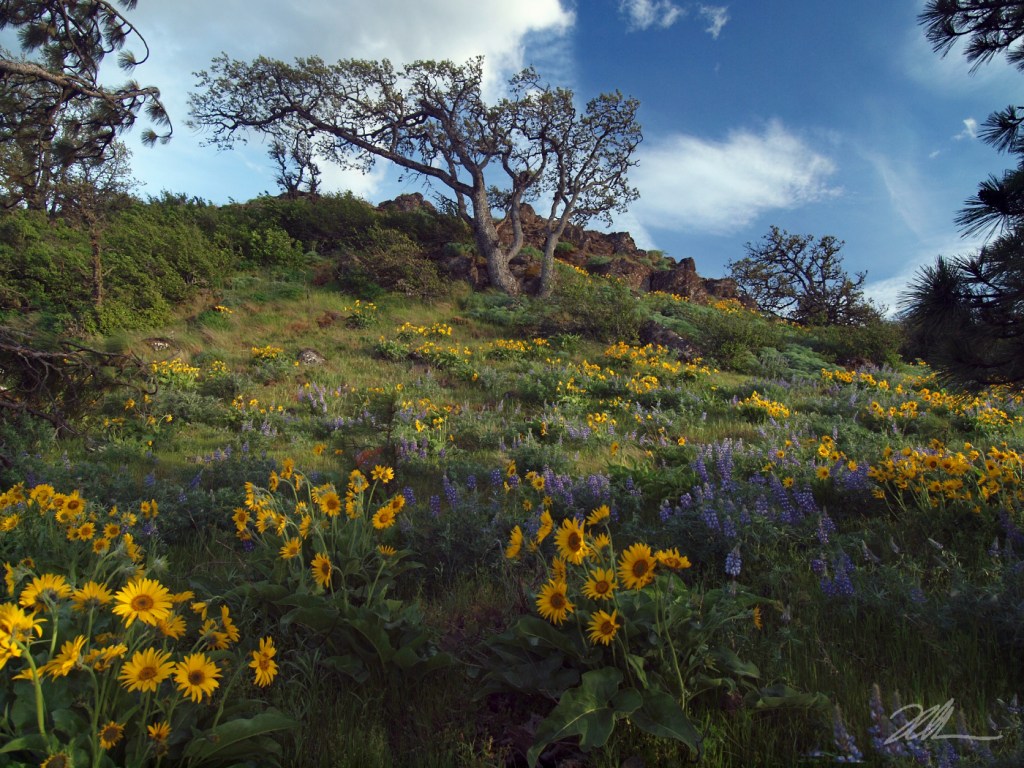
  • Photographers from around the world come here to capture this classic Columbia River Gorge landscape during the spectacular bloom season in April and early May, when yellow Balsamroot and blue Lupine blanket the wide, windswept meadows. 

    Much of the Rowena Crest landscape was rescued from private development in the late 1970s and 1980s as the Tom McCall Preserve by the Nature Conservancy of Oregon. The non-profit  continues to own and manage the land, and generously welcomes thousands of visitors each year to explore the trails here.

    ___________________

    Image Description: late afternoon sunlight casts long shadows during the annual wildflower spectacle at Rowena Crest in the Columbia River Gorge. Ponderosa pine boughs sway in the breeze in this scene, as a lone, wind-sculpted Oregon white oak begins to leaf out after weathering another stormy winter in the Gorge. Blooms of bright yellow Balsamroot (part of the sunflower family) and deep blue spikes of Lupine (a member of the pea family) complete the vibrant spring scene.

    Photo © WyEast Images (2026)

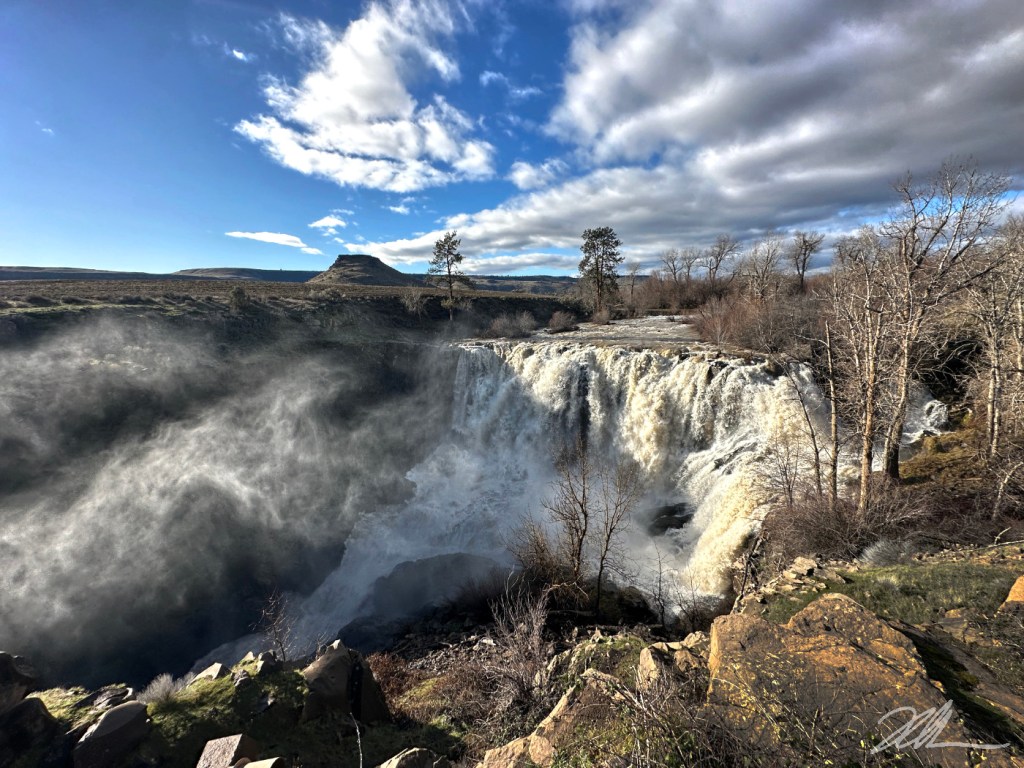
  • Two weeks of unusually heavy rain and mild temperatures erased much of the early snowpack on Mount Hood in mid-December of 2026, turning mountain streams and the rivers they feed into torrents. This was the scene in the sagebrush country east of the mountain at White River Falls, just one day after flood levels had peaked at more than ten feet on the river gauge. When this photo was taken the following morning, flood levels had already dropped to seven feet. This was still more than enough to create a thundering spectacle that easily exceed the high-water mark for the entire previous winter. 

    Morning sun rays added to the drama, lighting a heavy plume of mist that was billowing from the falls and rolling downstream into the narrow gorge, below. Blue skies and dissipating clouds overhead reveal the rain shadow effect of the Cascades that creates this desert landscape.

    _____________________

    Image Description: a wide, thundering waterfall swollen by storm runoff cascades over a sheer basalt cliff under blue skies with scattered clouds. The roaring water has tan and gold tints from river silt stirred up by the flooding. A grove of Cottonwood trees frames the falls, standing leafless and stark in winter. A pair of big Ponderosa pine grow along the White River just above the falls. A flat, rocky mesa rises in the distance, marking this as classic Oregon desert country.

    Photo © WyEast Images (2026)