

When the days get shorter each winter, and the sun is low on the southern horizon, thick mountain fog can seemingly appear out of nowhere as evening approaches on cold, clear days. Though invisible to our eye, the clear winter air is usually dense with water vapor barely held in suspension by the sun’s rays. As the sun begins to fade toward sundown, so does the energy needed to sustain vapor, and droplets of water quickly condense to form fog.
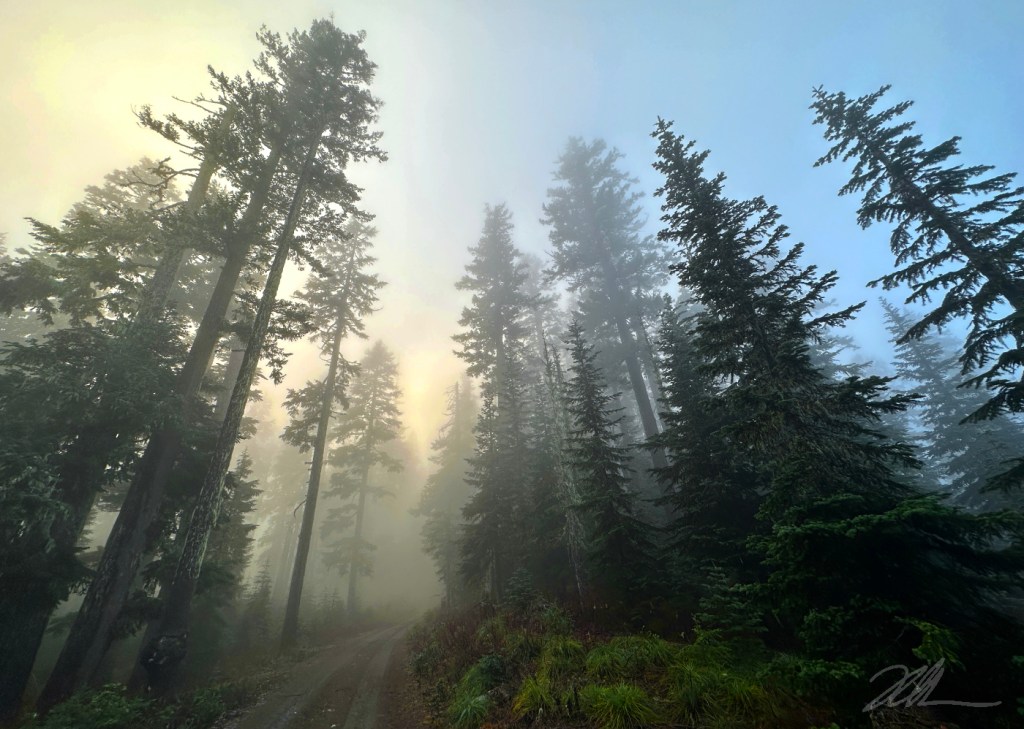
This scene is along the historic Bennett Pass Road where it follows the high ridge dividing the East Fork Hood River and White River valleys. The image captures a moment at the end of a late November when dense fog had already engulfed the East Fork valley (on the right), where the ridge had already blocked the setting sun. Fog was quickly forming on the White River side (left), as well, lit up in this scene with the last rays from the setting sun.
Ridges and peaks are often left as islands above the fog, with the heavy, condensed air sinking into valleys, below. In this scene, the fog buildup had nearly crested the ridge, though clear skies remained visible overhead.
___________
Image Description: Ancient Noble fir trees tower 150 feet above a narrow wagon road disappearing into flog along a forested Cascade Mountain ridgetop. The dense fog filters through the trees, partly illuminated gold and yellow with rays from the setting sun. Tufts of bright green Beargrass (an alpine member of the Lily family) grow in the foreground, their sword-shaped leaves heavy with dew.
Photo © WyEast Images (2026)
 WyEast Images