

Winter snow means the annual closure of Lolo Pass Road, and the beginning of a very quiet season on the rugged northwest side of Mount Hood. It’s a time of stunning beauty, when the colorful cliffs and spires familiar to summer hikers are blanketed in deep snow and ice. This image was captured in early winter, after the first big snowstorms had arrived, but before the coldest winter temperatures had set in, leaving Lolo Pass accessible with just a foot of snow to navigate.
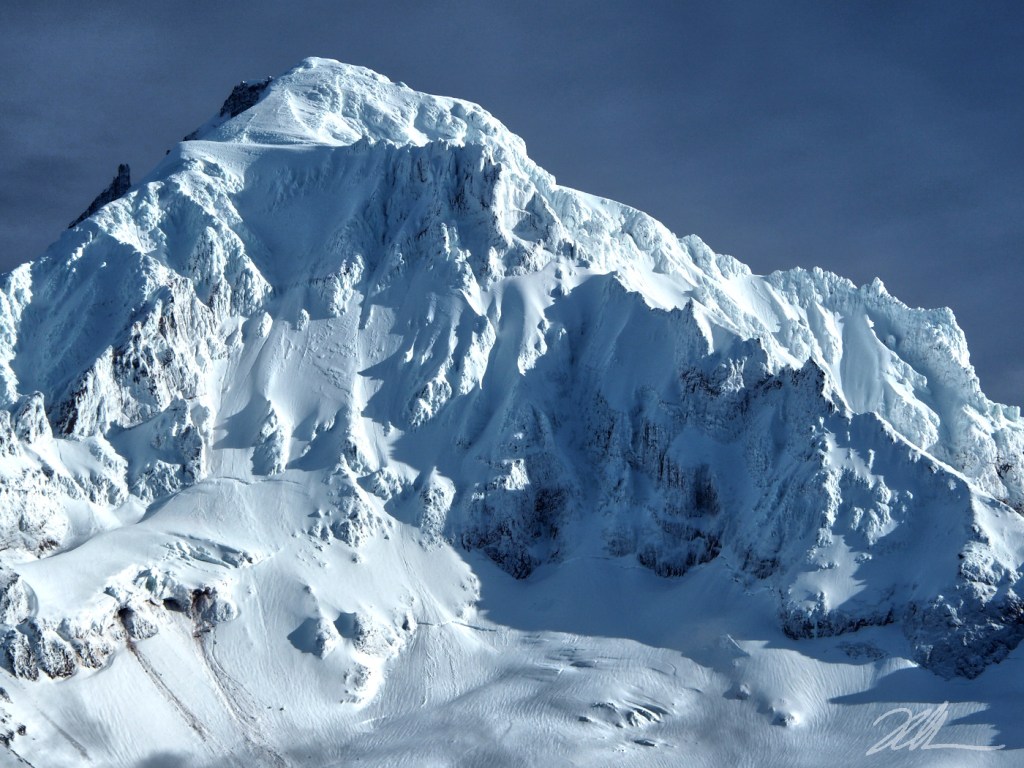
This perspective shows the imposing Sandy Headwall, a near-vertical 2,000-high ring of cliffs that shed constant snow avalanches to supply the Sandy Glacier. Crevasses seen in the lower part of this view mark the upper extent of the glacier.
Climate change is causing all of Mount Hood’s glaciers to recede, and the Sandy is among the most affected due to its comparatively low elevation. Its origin, at just 8,800 feet, is the lowest among the active glaciers on the mountain. This rapid melting led to the formation of the spectacular Sandy Glacier Caves several years ago, a much studied and documented phenomenon, though fleeting in their existence.
___________
Image Description: Rugged, pyramid-shaped Mount Hood is draped in heavy snow with long evening shadows creating contrasting shades of blue and white. Dark, rocky pinnacles and ridges push through the snow on the steepest parts of the mountain. Behind the mountain, the sky is a light mist of clouds against dark blue sky. Wrinkles in the smooth, snow-covered Sandy Glacier at the base of the mountain mark crevasses in the ice.
Photo © WyEast Images (2026)
 WyEast Images