

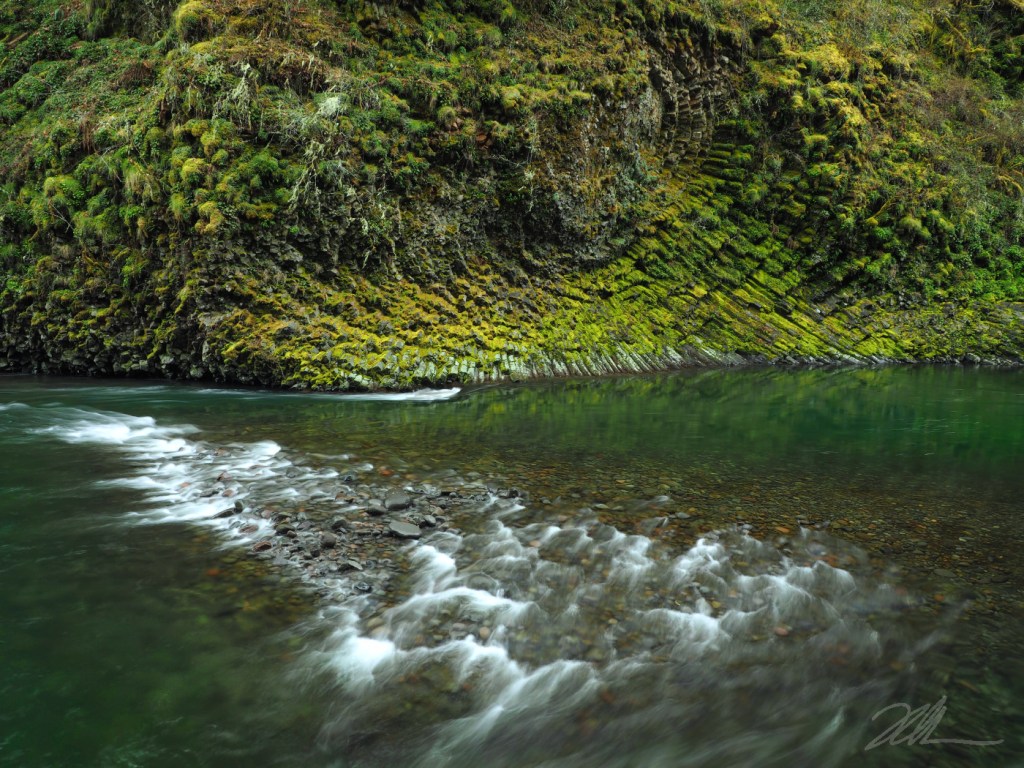
This striking basalt formation watches over a popular swimming hole in the lower Molalla River canyon. Columns often form when basalt lava cools, creating the familiar hexagonal rock pillars that are iconic throughout the Pacific Northwest. As lava cools, it shrinks from the top of the flow downward, slowing creating vertical cracks that define the columns. But, why are the pillars here arranged in the shape of a giant dinosaur eye? Scientists believe radiating column “rosettes” like these form in places where lava flowed into confined terrain or lava tubes, causing this uncommon, circular fracture pattern.
The Molalla Eye is part of the Columbia River flood basalts that flooded across much of eastern Oregon and Washington and extended as far as the Oregon Coast. These are the ancient basalts that we see in the cliffs of the Columbia River Gorge, in the lower Clackamas River canyon and that make up the rows of hills across the northern Willamette Valley, where the flows have become inverted basalt casts of ancient valleys that once existed. These massive basalt flows pre-date the Cascade Range, itself. As the Cascades grew and the Molalla carved its canyon, the river found a crack in this ancient basalt bedrock, sculpting it into the narrow gorge that reveals the eye and this beautiful pool.
___________
Image Description: a moss-covered cliff face of basalt columns arranged in a rosette around an eye of solid basalt rises above a glassy, still pool of deep green in the Molalla River. Shallow riffles in the river fill the foreground where it flows from the pool over colorful, rounded river cobbles.
Photo © WyEast Images (2026)
 WyEast Images
2 responses to “Molalla Eye (2018)”
I think of it as a lava tube that did not drain out before solidifying.
LikeLiked by 1 person
Yes, I think that the theory – and therefore cooled from the edges toward the center. Thanks for commenting, Mark!
LikeLike