

Despite the stunning beauty of Mount Hood’s northwest side, the Lolo Pass Road wasn’t built for hikers and nature photographer. Though the pass had long been a trade route for indigenous peoples, the modern road was only built in the mid-1950s, as part of constructing the transmission corridor linking the (then) new The Dalles Dam to the Willamette Valley grid.
With the drowning of Celilo Falls by the new dam in 1957 and the visual and ecological scars created by its four transmission lines crossing the Hood River Valley and Lolo Pass, the project remains the most environmentally and culturally destructive in WyEast history – one that could never be built today. Soon after the new road was completed, the Forest Service added a network of logging spurs from, clearcutting much of the adjacent Clear Fork Sandy River and West Fork Hood River valleys that flank Lolo Pass. In less than two decades, it was transformed from one of the most pristine to one of the most degraded places on the mountain.
Yet, its beauty endures. Despite the forest of steel towers and tangle of high-tension lines marring the views, the road became a popular scenic drive from the beginning – simply because of the stunning scenery. A few years ago, it was briefly re-imagined as a recreation corridor in a draft bill that would have protected Mount Hood as a national recreation area. While that bill didn’t advance, the idea of someday restoring places like Lolo Pass still holds, as the beauty of the area continues to remind of what it once was – and what it can still be.
___________
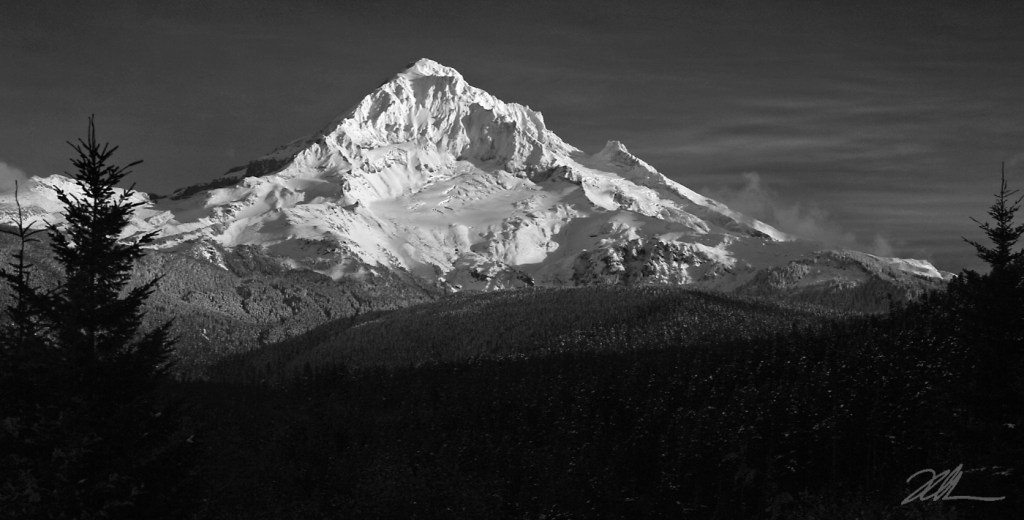
Image Description: A black-and-white image of Mount Hood in winter, as viewed from Lolo Pass Road. The snowy mountain is glowing in late evening light against a dark sky, the valleys and forests below hidden in shadows. The mountain’s steep west face is studded with crags and cliffs, the summit shaped in a perfect pyramid. The Sandy Glacier spreads out beneath the summit, with wrinkles on its smooth surface marking deep crevasses. The silhouettes of young Douglas fir trees in the foreground frame the scene.
Photo © WyEast Images (2026)
 WyEast Images