

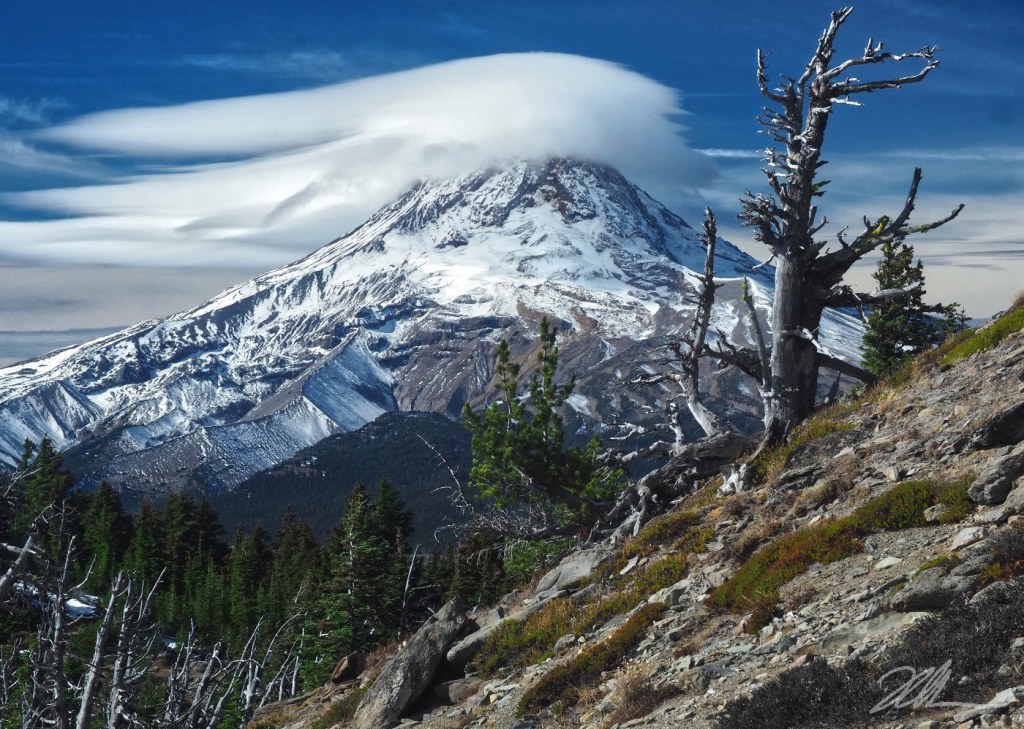
The Grasshopper Fire continues to spread along its eastern front, but the western part of the burn that encompasses Lookout Mountain and High Prairie has quieted since the fire began three weeks ago. This image from last November captures early snow on the mountain and a lenticular cloud that announces an incoming Pacific front (that can be seen on the horizon).
In the foreground, an isolated Whitebark pine colony survives at the very crest of the mountain, where the elevation reaches above 6,000 feet, the highest point in the Badger Creek Wilderness. Other than Mount Hood, itself, Lookout Mountain is the only peak in the area high enough to support this keystone alpine species.
The Lookout Mountain Whitebark grove is a mix of ancient, bleached skeletons, mature living trees and scattered young seedlings. Their physical isolation high above the rest of the dense, surrounding hemlock and fir forests (seen in the distance, below) is their best defense against wildfire, though we won’t know the fate of these trees until the area is reopened to the public, sometime after the fire.
___________
Image Description: Mount Hood is freshly covered in an early dusting of autumn snow, and capped with a lenticular cloud, a series of stacked saucer-shaped clouds that often mark the approach of an incoming storm front. In the foreground, the gnarled, bleached skeleton of an ancient Whitebark pine frames the view, with younger, living pines flanking the old giant. These trees grow on the steep, rocky slopes of Lookout Mountain, the highest point in the Badger Creek Wilderness.
Photo © WyEast Images (2026)

